The right choice depends on whether follicles are still miniaturising, shedding temporarily, inflamed, scarred, or permanently absent. By comparing diagnosis, treatment stage, maintenance, donor supply and realistic outcomes, you can decide when to observe, use medical HairLossSolutions, add a procedure, or consider HairRestoration surgery.
Key takeaways
- Confirm the cause of hair loss before choosing a procedure.
- Match treatment to your loss pattern, stage, and donor-area quality.
- Compare medicines, PRP, and low-level light therapy realistically.
- Investigate sudden shedding, scarring, eyebrow loss, or nail changes promptly.
Start with the Diagnosis, Not the Procedure
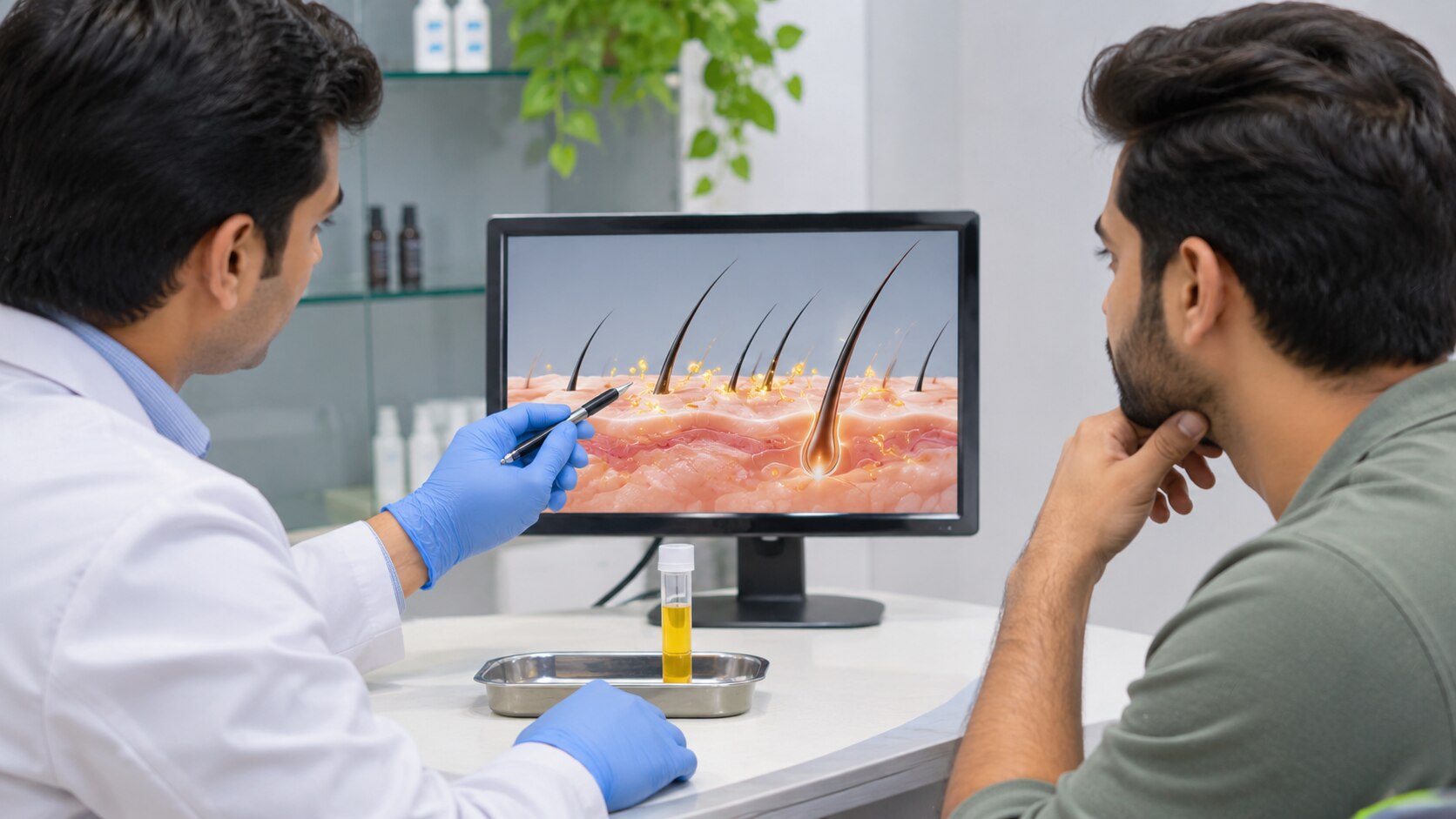
Before choosing HairLossSolutions, establish whether follicles are miniaturising, shedding temporarily, or being destroyed. A clinician reviews onset, speed, family pattern, recent fever or illness, weight change, childbirth, diet, medicines, and hairstyles. The examination includes the hairline, crown, entire scalp, eyebrows, nails, and donor area, supported by standardised photographs and trichoscopy (dermoscopy of the scalp).
Ask the clinician to check:
- Hair density, shaft thickness, miniaturised hairs, and the pattern of recession or crown loss
- Smooth patches, exclamation-mark hairs, broken hairs, perifollicular scale, redness, pustules, or tenderness
- Whether follicular openings remain visible; a shiny scalp without openings raises concern for scarring alopecia
- Blood tests such as ferritin, complete blood count, and thyroid testing when diffuse shedding or systemic symptoms suggest iron deficiency, thyroid disease, or another cause
| Finding | More consistent with | Treatment implication |
|---|---|---|
| Miniaturised hairs at temples or crown | Androgenetic alopecia | Grade patterned loss with Norwood-Hamilton, Ludwig, or Sinclair scales; assess progression and donor density |
| Smooth patches, eyebrow loss, or nail changes | Alopecia areata | Dermatologic treatment takes priority over cosmetic restoration |
| Diffuse shedding after illness, major stress, childbirth, or dieting | Telogen effluvium | Identify the trigger before considering procedures |
| Broken hairs, scale, pain, pustules, or absent follicular openings | Traction, infection, inflammatory, or scarring disease | Prompt assessment, possible biopsy or laboratory testing; transplantation may worsen the problem |
Stage depends on density, miniaturisation, progression, and donor supply—not just the size of a bald patch. A transplant redistributes finite donor follicles, so diagnosis and stability come before any BaldnessTreatmentInPune decision.
Match Treatment to the Pattern and Stage of Loss
An early receding hairline, crown thinning or diffuse miniaturisation has more treatment options than a smooth, shiny bald area. A BaldnessTreatmentInPune plan should match the pattern, follicle viability and donor supply rather than the amount of hair currently missing.
| Option | Best match | Practical approach |
|---|---|---|
| Early thinning | Miniaturised but viable follicles | Use topical minoxidil; consider oral finasteride for suitable men after discussing adverse effects. PRP or low-level light therapy may serve as adjuncts, not replacements. |
| Established patterned loss | Progressive Norwood or Ludwig pattern | Stabilise ongoing loss medically, then reassess photographs after about 3–6 months. Use camouflage for immediate coverage. |
| Advanced baldness | Stable, smooth areas with adequate donor hair | Medication cannot normally repopulate completely lost follicles. Consider transplantation after assessing donor density and future loss. |
| Sudden diffuse shedding | Hair loss beginning 2–3 months after illness, fever, childbirth, severe stress or crash dieting | Investigate and correct the trigger; do not rush to transplant. Regrowth often takes months. |
| Limited donor area | Sparse occipital or temporal supply, or extensive previous surgery | Prioritise medical stabilisation and realistic camouflage. A transplant redistributes finite follicles; it cannot create new donor hair. |
Patchy loss, scalp inflammation or rapid shedding needs a different diagnostic pathway before routine pattern treatment. Trichoscopy and review of medicines, illnesses and blood tests for suspected iron or thyroid problems help prevent an unsuitable procedure.
Compare Medical Treatments, PRP and Low-Level Light Therapy
Do not confuse slowing active loss with restoring hair in a bald area. These HairLossSolutions work on different timelines, and most require continued use to preserve gains.
| Option | Main purpose | Timing and maintenance |
|---|---|---|
| Topical minoxidil | Supports growth and reduces thinning | Assess after 3–6 months; continue indefinitely or shedding usually returns |
| Oral medicines | Slow pattern loss; finasteride targets DHT, while oral minoxidil is off-label | Requires prescription, risk review and ongoing treatment; oral minoxidil can cause dizziness, edema, tachycardia or excess facial hair |
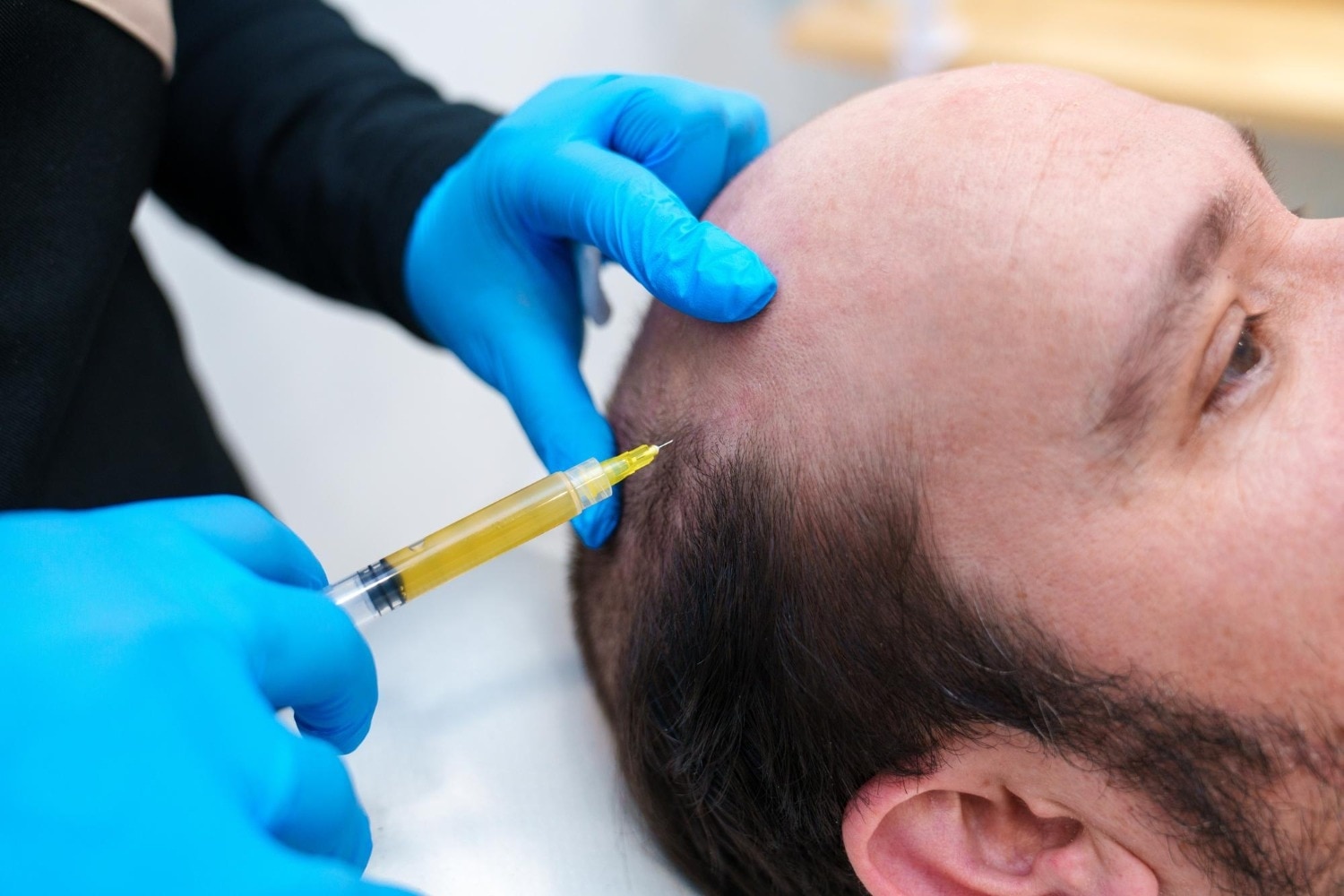
| PRP | Adjunct stimulation for miniaturized follicles | Benefits are assessed after repeated injection sessions; maintenance may be needed |
| Low-level light therapy | Modest support for some androgenetic alopecia | Requires regular device sessions for months; it will not fill a completely bald scalp |
| Microneedling | Creates controlled injury and may enhance medical treatment | Usually planned as an adjunct in repeated sessions; avoid over irritated or infected skin |
| Camouflage | Hides visible scalp with fibers, sprays or hairpieces | Immediate but temporary; reapply, wash out or replace as needed |
Minoxidil, PRP, light therapy and microneedling cannot create unlimited follicles. Oral medicines also need medical screening, especially with heart, blood-pressure or kidney conditions. Camouflage suits urgent cosmetic coverage, while HairRestoration surgery requires a stable diagnosis and adequate donor hair. A clinician can sequence these options rather than treating every stage with the same plan.
Decide Whether a Hair Transplant Is Appropriate
A transplant is sensible only when the diagnosis is clear, hair loss is stable, and the donor supply can support both today’s design and future thinning. It redistributes existing follicles; it does not create new donor hair.
| Check | Proceed when | Defer or avoid when |
|---|---|---|
| Diagnosis | Dermoscopy supports stable androgenetic alopecia | Loss is patchy, sudden, inflammatory, infectious or scarring |
| Donor area | Occipital and temporal density, hair caliber and curl provide enough grafts | Donor density is low or overharvesting would be likely |
| Stability | Pattern loss has been assessed over time and medical treatment is controlling progression | Hair loss is rapidly advancing or the diagnosis remains uncertain |
| Planning | Hairline, crown, graft numbers and possible future sessions are mapped | The plan uses too many grafts now or ignores later native-hair loss |
FUE removes individual follicular units and avoids a linear strip scar, but excessive extraction can leave widespread dot scarring. FUT removes a strip and leaves a linear scar, yet can provide many grafts in one session. Neither method fixes poor diagnosis, graft handling or unrealistic design.
A scalp examination with trichoscopy, photographs and a medication and illness history should come before scheduling surgery. Request blood tests when shedding suggests iron deficiency, thyroid disease or another systemic cause. Keratis Clinic - Best Skin Specialist-08048037869 can assess these factors before recommending a procedure, rather than treating every case as surgical BaldnessTreatmentInPune.
For sound HairRestoration planning, stabilise active disease and consider medical treatment before surgery.
Related services
Dermatosurgery Hair Transplant in Baner, Aundh, Pashan,Bavdhan,Wakad, Pune Hair Transplant in Baner, Pune Advanced Hair Transplant by Dr. View service → |
Skin, Hair & Nail Care Hair Loss Treatment in Baner, Aundh, Pashan,Bavdhan,Wakad, Pune Hair Loss Treatment in Baner, Pune Advanced Hair Loss Treatment by Dr. View service → |
Recognise Hair Loss That Needs a Different Pathway
Gradual recession at the temples or crown with finer hairs usually fits androgenetic, or pattern, baldness. Rapid change, sharply defined patches, inflammation, or loss beyond the usual scalp pattern points to another diagnosis. Trichoscopy can show exclamation-mark hairs, broken hairs, perifollicular scale, or missing follicular openings.
| Condition | Clues that separate it from pattern baldness | Usual next step |
|---|---|---|
| Alopecia areata | Smooth round patches, eyebrow loss, nail pits, exclamation-mark hairs | Dermatology assessment; anti-inflammatory treatment may be needed |
| Telogen effluvium | Diffuse shedding beginning about 2–3 months after fever, childbirth, severe stress, illness, or crash dieting | Find the trigger; consider iron or thyroid testing |
| Traction alopecia | Broken hairs and thinning along the hairline after tight braids, extensions, buns, or helmets | Stop tension early; permanent loss can follow |
| Infection | Itching, marked scale, pustules, crusting, tenderness, or broken hairs | Examination and targeted antimicrobial treatment |
| Scarring alopecia | Pain, burning, redness, pustules, or shiny skin without follicular openings | Urgent assessment; biopsy and disease control may protect remaining follicles |
| Medication-related shedding | Diffuse loss after starting, stopping, or changing a medicine | Review every prescription and supplement with the prescriber |
Do not choose HairLossSolutions or BaldnessTreatmentInPune from photographs alone when these signs appear. Active scarring or infection needs control before transplantation, while sudden shedding usually needs cause correction and observation; a transplant through active disease can worsen loss and waste grafts.
Frequently asked questions
Why should diagnosis come before choosing a hair-restoration procedure?
A clinician must distinguish follicle miniaturisation from temporary shedding or follicle destruction. The assessment covers your history, hairline, crown, full scalp, eyebrows, nails, donor area, photographs, and trichoscopy.
How should treatment be matched to the stage and pattern of hair loss?
Treatment depends on whether loss is patterned, diffuse, patchy, or advancing, along with the condition of the donor area. Stabilise active loss before considering a transplant.
How do medical treatments, PRP, and low-level light therapy differ?
Medical treatments target the biological process behind patterned loss, while PRP and low-level light therapy are non-transplant options with different evidence, schedules, costs, and suitability. Discuss expected gains and maintenance before starting.
When is a hair transplant appropriate?
A transplant is appropriate when hair loss is sufficiently assessed or stabilised, the donor area contains usable follicles, and the planned density matches available grafts. It does not stop future miniaturisation in untreated hair.
Which signs suggest a different hair-loss pathway?
Sudden shedding, round bald patches, scalp inflammation or pain, scarring, eyebrow loss, nail changes, or loss after illness, weight change, childbirth, dietary restriction, or medication require investigation before cosmetic treatment.
Related services
Skin, Hair & Nail Care Hair Fall Treatment in Baner, Aundh, Pashan,Bavdhan,Wakad, Pune Hair Fall Treatment in Baner, Pune Advanced Hair Fall Treatment by Dr. View service → |
Dermatosurgery PRP Therapy in Baner, Aundh, Pashan,Bavdhan,Wakad, Pune PRP Therapy in Baner, Pune Advanced PRP Therapy by Dr. Snehal Navande-Kodgire at Keratis Clinic PRP (Platelet-Rich Plasma) Therapy is an advanced... View service → |
Skin, Hair & Nail Care Trichology Consultation in Baner, Aundh, Pashan,Bavdhan,Wakad, Pune Trichology Consultation in Baner, Pune Expert Hair & Scalp Consultation by Dr. View service → |
Keywords